

By Vohra & Vohra
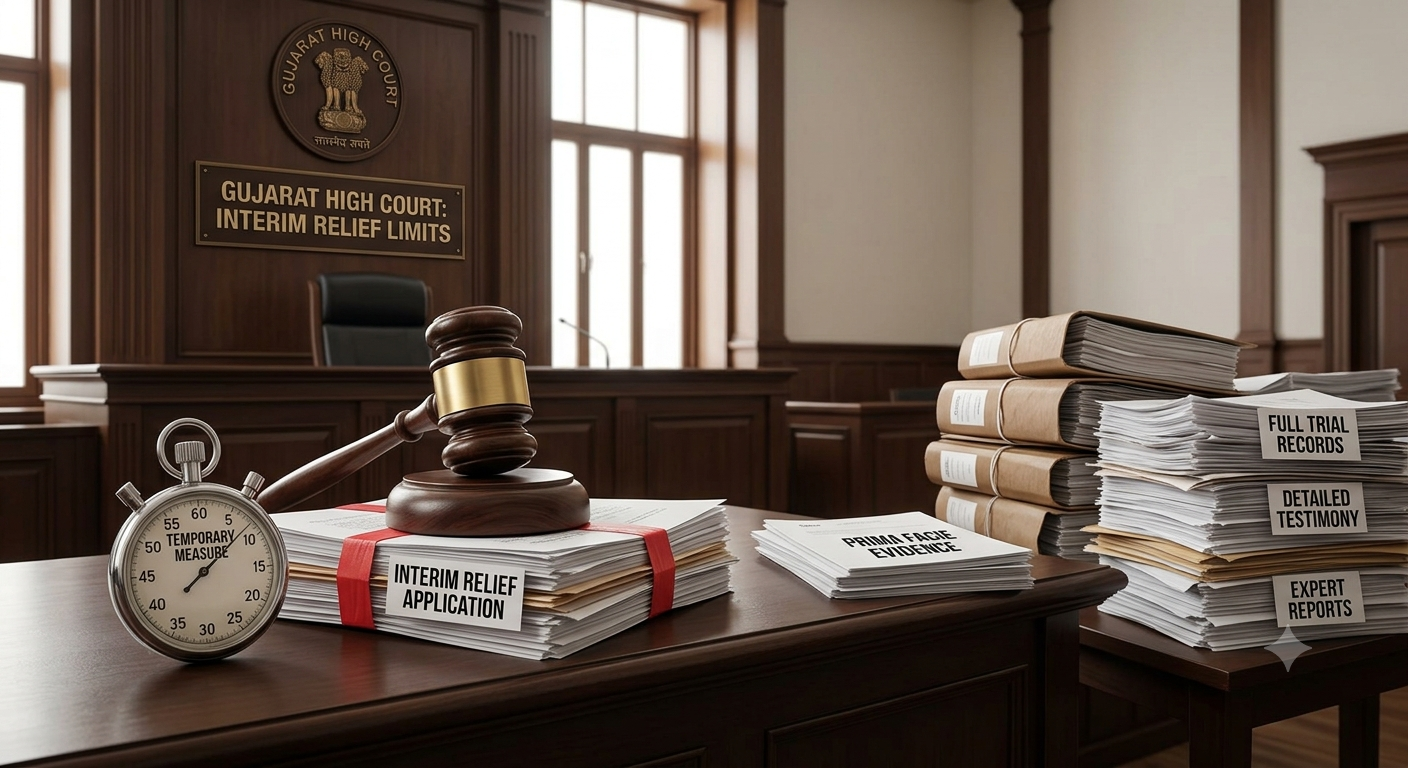
Interim injunctions play a vital role in trademark litigation. They preserve the status quo, prevent continuing harm to goodwill and reputation, and protect commercial interests pending final adjudication. Yet, the extraordinary nature of interim relief demands judicial restraint. Court s are not expected to finally determine disputed questions of title, prior use, or goodwill at the interlocutory stage.
The Gujarat High Court’s judgment dated 28 July 2026 in Tinubhai Babubhai Bhalgama & Ors. v. Alpeshbhai Ranchhodbhai Lunagariya & Ors. is a significant reaffirmation of this principle. Setting aside an interim injunction granted by the Commercial Court, the Division Bench held that a court considering an application for temporary injunction cannot undertake a “mini trial” by evaluating the reliability or sufficiency of evidence or by conclusively determining disputed questions of fact.
The decision provides valuable guidance on the interplay between prior use, statutory registration, passing off, and the evidentiary standards governing interlocutory relief in trademark disputes.
Background of the Dispute
The dispute arose between competing jewellery businesses using the name “Aditya Jewellers.” The plaintiff claimed continuous use of the mark since 2007, asserting that extensive advertising, substantial turnover, and long-standing commercial use had enabled the mark to acquire significant goodwill, reputation, and secondary meaning. The plaintiff also relied upon a pending trademark application and alleged that the defendants had adopted deceptively similar marks with the intention of trading upon its reputation.
The defendants contested these assertions. They pleaded that they had been using “Aditya Jewellers” since 2002, were the registered proprietors of the mark, and supported their defence with registration certificates, invoices, income tax records, user affidavits, and other documentary evidence. They further argued that the plaintiff’s mark remained unregistered and that, by virtue of Sections 27(1) and 28 of the Trade Marks Act, their statutory rights could not lightly be displaced.
Despite these competing claims, the Commercial Court granted an interim injunction restraining the defendants from using the impugned marks pending trial.
The Trial Court’s Approach
The Commercial Court accepted the plaintiff’s argument that its business had achieved significantly higher turnover and wider market recognition. It also questioned the reliability of the defendants’ documentary evidence, observing that certain invoices appeared incomplete and insufficient to establish continuous use. On that basis, it concluded that the plaintiff had established a prima facie case, that the balance of convenience favoured the plaintiff, and that irreparable injury would result if the injunction were refused.
The defendants challenged this order before the Gujarat High Court.
Interim Proceedings Cannot Become a Mini Trial
The Division Bench identified a fundamental legal error in the Commercial Court’s reasoning.
The High Court observed that while deciding an application for temporary injunction, a court is required to examine only whether the plaintiff has established a prima facie case, whether the balance of convenience favours the grant of relief, and whether refusal would cause irreparable injury.
The Court held that the Commercial Court had travelled beyond these settled parameters by assessing the reliability of the defendants’ documentary evidence and virtually deciding disputed factual issues that properly belonged to the stage of trial. Such an exercise amounted to conducting a mini trial, which is impermissible at the interlocutory stage.
This observation is particularly significant because courts frequently encounter conflicting claims of prior use supported by rival documentary records. The judgment clarifies that these disputes should ordinarily be resolved through evidence and cross-examination, not at the interim stage.
Registration and Prior Use Cannot Be Ignored
Another important aspect of the judgment is its treatment of the defendants’ statutory rights.
The High Court noted two undisputed facts:
- the defendants were registered proprietors of the trademark; and
- the defendants had produced material supporting their plea of prior use since 2002.
While the Court did not conclusively determine the correctness of those claims, it held that the existence of registration and evidence of prior use substantially weakened the plaintiff’s assertion that a prima facie case of infringement had been established.
The Court therefore held that the Commercial Court could not disregard these factors while granting interim relief.
Turnover Alone Does Not Establish Goodwill
One of the most noteworthy observations concerns the concept of goodwill.
The Commercial Court had relied heavily on the plaintiff’s significantly larger turnover and extensive advertising expenditure to conclude that the plaintiff had acquired superior goodwill.
The High Court disagreed.
It held that goodwill, reputation, dishonest adoption, and entitlement to protection as a well-known mark involve disputed factual questions that require evidence during trial. These issues cannot be conclusively determined merely because one business records higher sales than another.
This is an important clarification for trademark litigation. While turnover and advertising are relevant considerations, they are not substitutes for a proper evidentiary inquiry into reputation and consumer perception.
The Primacy of the Prima Facie Case
The judgment also reiterates the interrelationship between the three traditional requirements governing temporary injunctions.
The Court held that where the plaintiff fails to establish a strong prima facie case, the remaining considerations of balance of convenience and irreparable injury ordinarily cannot independently justify the grant of injunction. Since the defendants were registered proprietors asserting prior use, the plaintiff’s entitlement to relief required a much more detailed factual examination than was possible at the interlocutory stage.
Accordingly, the Division Bench set aside the interim injunction while clarifying that the trial court remained free to decide the suit independently on the basis of evidence adduced by the parties.
Implications for Trademark Litigation
The decision offers important lessons for litigants and practitioners.
First, applications for interim injunction must focus on demonstrating a clear prima facie entitlement rather than inviting the court to resolve disputed questions of fact.
Secondly, businesses relying upon prior use should preserve comprehensive documentary records because such evidence may significantly influence the court’s assessment at the interlocutory stage.
Thirdly, registration of a trademark continues to confer valuable statutory rights that cannot be lightly displaced merely because another party claims greater commercial success.
Finally, the judgment reinforces judicial discipline by reminding courts that interim proceedings are intended to preserve rights—not to finally determine them.
Conclusion
The Gujarat High Court’s decision in Tinubhai Babubhai Bhalgama & Ors. v. Alpeshbhai Ranchhodbhai Lunagariya & Ors. is an important reaffirmation of the limited yet vital function of interim injunctions in trademark disputes.
By holding that interlocutory proceedings cannot become a substitute for trial, the Court has reinforced the procedural safeguards that underpin commercial litigation. The judgment also highlights the significance of statutory registration, competing claims of prior use, and the evidentiary threshold required before a court restrains a business from using its trademark. For businesses and trademark practitioners alike, the ruling serves as a timely reminder that interim relief protects rights—it does not determine them.