

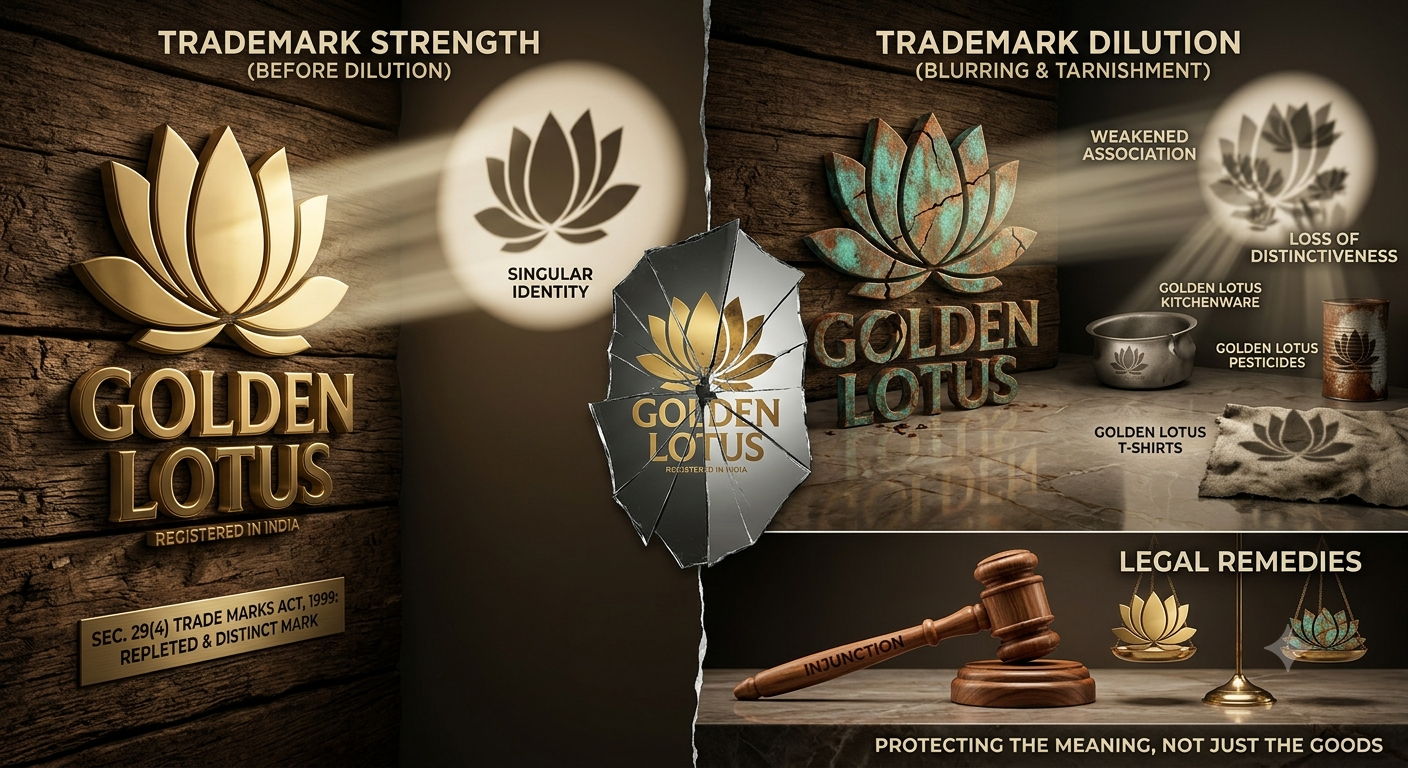
Most trademark disputes are about confusion. Two similar marks in the same market space, consumers unable to tell them apart, sales diverted, goodwill eroded. That’s the classic infringement scenario.
But there’s a different kind of harm — more subtle, sometimes more damaging to a major brand — called trademark dilution. It doesn’t require confusion. It doesn’t require competing products. And it can happen even when the infringer is operating in an entirely different industry.
What Is Trademark Dilution?
Dilution occurs when a third party uses a sign identical or similar to a famous trademark in a way that weakens the trademark’s distinctive character or harms its reputation — without necessarily causing consumer confusion.
The two classic forms:
Blurring: The famous mark’s uniqueness is eroded because it’s being used by too many unrelated businesses. When a budget shoe brand calls itself “Rolls Royce,” it blurs the exclusive association between that name and luxury automobiles, even if no one mistakes shoes for cars.
Tarnishment: The famous mark’s reputation is damaged by association with inferior, offensive, or otherwise undesirable products or services. Using a prestigious brand name in connection with low-quality goods, adult content, or scandalous material harms the brand’s image — even without confusion.
The Indian Legal Framework
Section 29(4) of the Trade Marks Act, 1999 is the key provision. It states that a registered trademark is infringed where a person uses a mark identical or similar to the registered mark in the course of trade, in relation to goods or services that are not similar to those covered by the registration, where the registered mark has a reputation in India and the use of the mark takes unfair advantage of, or is detrimental to, the distinctive character or repute of the registered mark.
The provision has three key elements:
The registered mark must have a reputation (typically well-known status). The third party’s use must be in the course of trade. The use must take unfair advantage of, or cause detriment to, the mark’s distinctive character or reputation.
Notably, confusion between goods or services is not required. The harm is to the mark’s distinctive power and reputation, not to consumer purchasing decisions.
Indian Cases on Dilution
Indian courts have recognised and applied the dilution doctrine in several landmark cases.
In Daimler Benz AG vs. Hybo Hindustan, the Delhi High Court prevented a manufacturer from using the Mercedes three-pointed star on underwear. The court held that even though there was no possibility of confusion between cars and undergarments, the use of an identical mark would tarnish and dilute the Mercedes brand’s prestige.
In Rolex SA vs. Alex Jewellery, the same principle was applied to protect the Rolex brand against use in a different product category.
The Yahoo! vs. Akash Arora domain name case is another frequently cited example — where the court recognised that using a famous brand’s name in a domain for a competing website creates harm to the brand’s distinctiveness and reputation.
Who Can Invoke Dilution Protection?
The practical answer is: brands with well-known or famous trademark status.
Section 29(4) applies where the mark “has a reputation in India.” The higher the brand’s recognition and the stronger its association with quality and prestige, the more easily dilution can be demonstrated.
This is one of the practical reasons to pursue formal well-known trademark recognition. It is not just a prestige marker — it is a legal prerequisite for the strongest form of cross-class brand protection.
Online Dilution
Digital environments have created new forms of dilution. Domain name squatting using famous marks. Keyword advertising using competitor trademarks. Social media handles that appropriate a brand’s name in an unrelated context.
Each of these can constitute dilution under Indian law, and platform-specific remedies (UDRP for domain names, platform reports for social media) are available alongside traditional legal action.
Building a Dilution-Resistant Brand
The best protection against dilution is a combination of:
Formal well-known trademark status, achieved proactively Comprehensive monitoring of trademark filings, domain registrations, and online use Consistent and prompt enforcement against any use that could blur distinctiveness or tarnish reputation Customs recordal to intercept counterfeit goods at the border
Dilution operates slowly. It’s the cumulative effect of many uncontested uses that erodes the brand’s uniqueness over time. An enforcement posture that responds to each diluting use as it appears — rather than waiting until the damage is done — is the most effective long-term strategy.