

By Vohra & Vohra
Introduction
Indian trademark law has consistently recognised that registration, commercial reputation and even the status of a well-known trademark do not invariably confer an absolute monopoly over every conceivable product category. While statutory registration undoubtedly grants valuable proprietary rights, those rights remain subject to one of the oldest and most fundamental principles of trademark jurisprudence—the doctrine of prior user.
The long-running litigation between Kent RO Systems Limited and Kent Cables Private Limited has brought this principle into sharp focus. In a significant development, the Supreme Court declined to interfere with the Delhi High Court’s interim order restraining Kent RO from manufacturing and selling fans under the “KENT” trademark while permitting Kent Cables to continue its business in the fan segment. The Court found no legal infirmity in the High Court’s exercise of discretion and directed that the cross-suits pending before the Delhi High Court be heard expeditiously.
Although the Supreme Court has not finally adjudicated the rights of the parties, the litigation offers important insights into the interplay between prior user rights, natural expansion of business, delay in enforcement and the scope of interim relief under Indian trademark law.
The Dispute
The controversy does not concern ownership of the “KENT” trademark in its entirety. Instead, it concerns the parties’ competing claims over the use of the mark in relation to electric fans.
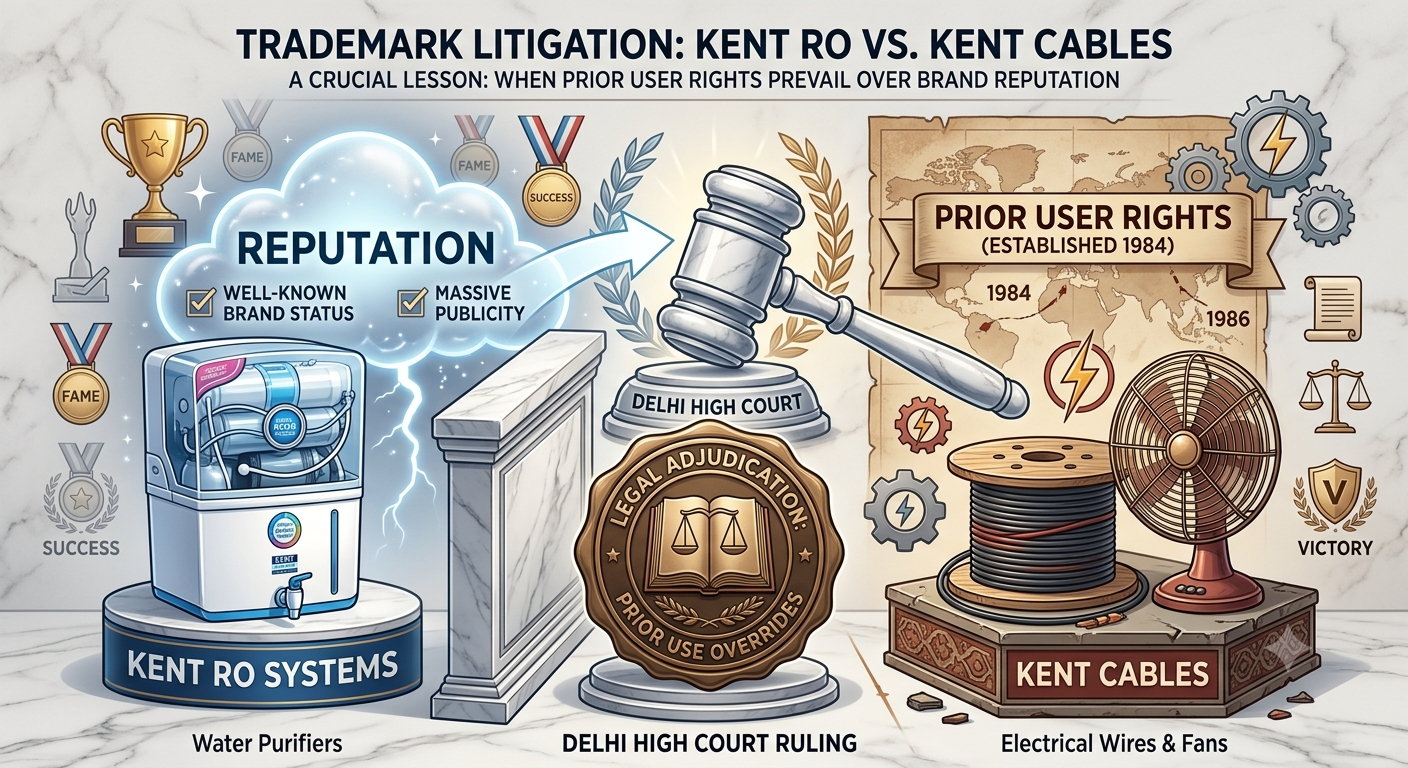
Kent Cables asserted that it adopted the KENT mark as early as 1984 in respect of electrical goods and secured registration in 1986. According to the material placed before the Court, it had diversified into electrical appliances and had been commercially using the mark for fans since at least 2009, supported by invoices, advertisements, government approvals and regulatory certifications.
Kent RO, on the other hand, built one of India’s most recognised household appliance brands through its extensive business in water purifiers, air purifiers and several other consumer products under the KENT trademark. Relying upon its enormous goodwill and multiple trademark registrations, Kent RO sought to expand into the fan segment, contending that its reputation extended across household appliances and that separate registrations for every individual product were unnecessary.
The Delhi High Court, however, found that Kent Cables had prima facie established earlier commercial use of the KENT mark in relation to fans and consequently restrained Kent RO from manufacturing and selling fans under the impugned mark pending adjudication of the suits.
Prior User Continues to Occupy a Superior Position
Perhaps the most important lesson emerging from the litigation is the continuing strength of the prior user doctrine.
Section 34 of the Trade Marks Act, 1999 preserves the rights of a person who has continuously used a trademark prior to the use or registration claimed by another proprietor. The provision reflects the long-established common law principle that trademark rights originate through commercial use rather than registration alone.
The High Court’s interim findings illustrate this principle in practice. Despite Kent RO’s extensive commercial reputation across multiple consumer products, the Court was persuaded that Kent Cables had demonstrated prima facie use of the mark for fans considerably earlier than Kent RO’s proposed entry into that product category. Documentary material including invoices, certifications and advertisements assumed considerable significance in establishing continuous commercial use.
The litigation therefore reinforces an important proposition: a well-known trademark does not automatically extinguish the rights of an earlier honest user in a distinct line of goods.
Reputation Cannot Replace Product-Specific Goodwill
One of the more nuanced aspects of the dispute concerns the distinction between brand reputation and product-specific goodwill.
Kent RO undoubtedly enjoys widespread recognition in India. Nevertheless, the High Court appears to have distinguished the company’s reputation in water purification and allied appliances from the specific market for electric fans.
Trademark law does not presume that goodwill developed in one category necessarily extends to every future commercial expansion. Where another trader has already established independent goodwill in a particular segment through continuous use, the proprietor of a famous mark may encounter legal limitations upon entry into that market.
The litigation therefore illustrates that brand diversification remains subject to existing proprietary rights acquired through prior commercial use.
Natural Expansion of Business
Equally significant is the High Court’s recognition of natural commercial expansion.
Kent Cables’ historical business consisted primarily of electrical wires, cables and allied electrical products. The Court accepted, at least prima facie, that the manufacture and sale of electric fans represented a logical extension of its existing business rather than an artificial attempt to appropriate another’s reputation.
This aspect of the judgment carries considerable practical importance.
Businesses routinely diversify into commercially connected product categories. Courts therefore assess trademark disputes not merely by examining the competing products in isolation but also by evaluating whether expansion into adjacent markets represents a natural progression of an established business.
For enterprises operating in sectors such as consumer electronics, automotive components, healthcare or FMCG, the principle assumes particular relevance.
Delay Remains an Important Equitable Consideration
Another noteworthy aspect of the litigation concerns delay in enforcement.
The High Court took note of the fact that Kent RO had opposed Kent Cables’ trademark application as early as 2007 and had issued a cease-and-desist notice in 2011, yet did not institute legal proceedings until 2022.
While delay does not necessarily extinguish statutory trademark rights, it assumes considerable importance when a party seeks discretionary interim relief.
Courts exercising equitable jurisdiction expect proprietors to act diligently. Where a claimant knowingly permits another business to continue commercial operations over several years before approaching the Court, such conduct may materially influence the balance of convenience and the assessment of irreparable injury.
The Kent litigation therefore serves as a reminder that timely enforcement remains essential to effective trademark protection.
Limited Scope of Appellate Interference
The Supreme Court’s order is equally significant from a procedural perspective.
Rather than re-evaluating disputed questions of fact, the Court confined itself to examining whether the High Court had committed any manifest legal error while exercising its discretionary jurisdiction.
Finding none, the Supreme Court declined to interfere with the interim injunction and instead directed that the pending cross-suits be heard at the earliest.
The order reinforces the settled principle that appellate courts ordinarily exercise restraint while reviewing interlocutory discretionary orders unless the decision suffers from patent illegality, perversity or jurisdictional error.
This approach promotes certainty in commercial litigation and discourages repeated appellate challenges to interim orders founded upon prima facie factual assessments.
Practical Lessons for Businesses
The Kent litigation offers several valuable lessons for trademark proprietors.
First, businesses seeking to diversify into new product categories should conduct comprehensive trademark due diligence, even where they possess long-standing registrations and substantial goodwill.
Secondly, enterprises relying upon prior use should preserve invoices, advertisements, regulatory approvals, catalogues and sales records demonstrating continuous commercial use over time. Such evidence frequently proves decisive during interlocutory proceedings.
Thirdly, trademark owners should enforce their rights promptly. Delay in commencing proceedings may substantially weaken the prospects of obtaining interim protection.
Finally, businesses should appreciate that well-known status is not synonymous with universal exclusivity. Trademark rights remain contextual and continue to coexist with the statutory protection afforded to prior users under Indian law.
Conclusion
The Kent RO–Kent Cables litigation is far more than a dispute between two businesses sharing a common trademark. It is an important reaffirmation of a foundational principle underlying Indian trademark law—that commercial priority continues to outweigh commercial popularity.
By declining to interfere with the Delhi High Court’s interim order, the Supreme Court has reinforced the significance of prior user rights, recognised the legitimacy of natural business expansion, and underscored the importance of timely enforcement in trademark litigation. While the final determination awaits trial, the litigation already serves as a compelling reminder that the strength of a brand is measured not only by its reputation but also by the chronology and continuity of its commercial use. For businesses navigating increasingly competitive markets, the decision offers a clear lesson: building a famous trademark is invaluable, but respecting the rights of an earlier honest user remains equally indispensable.