
Copyright is one of those legal concepts that most businesses assume they understand — and most of them have it partially wrong.
Yes, copyright arises automatically on creation. No, you don’t need to register it. But those two correct facts lead many business owners into a false sense of security about assets that can be worth far more than their trademark portfolio.
Here is a precise, practitioner-level guide to how copyright actually works in India.
What Copyright Protects
The Copyright Act 1957 governs intellectual property in original works across eight categories: literary works, artistic works, musical works, dramatic works, cinematographic films, sound recordings, broadcasts, and computer programmes.
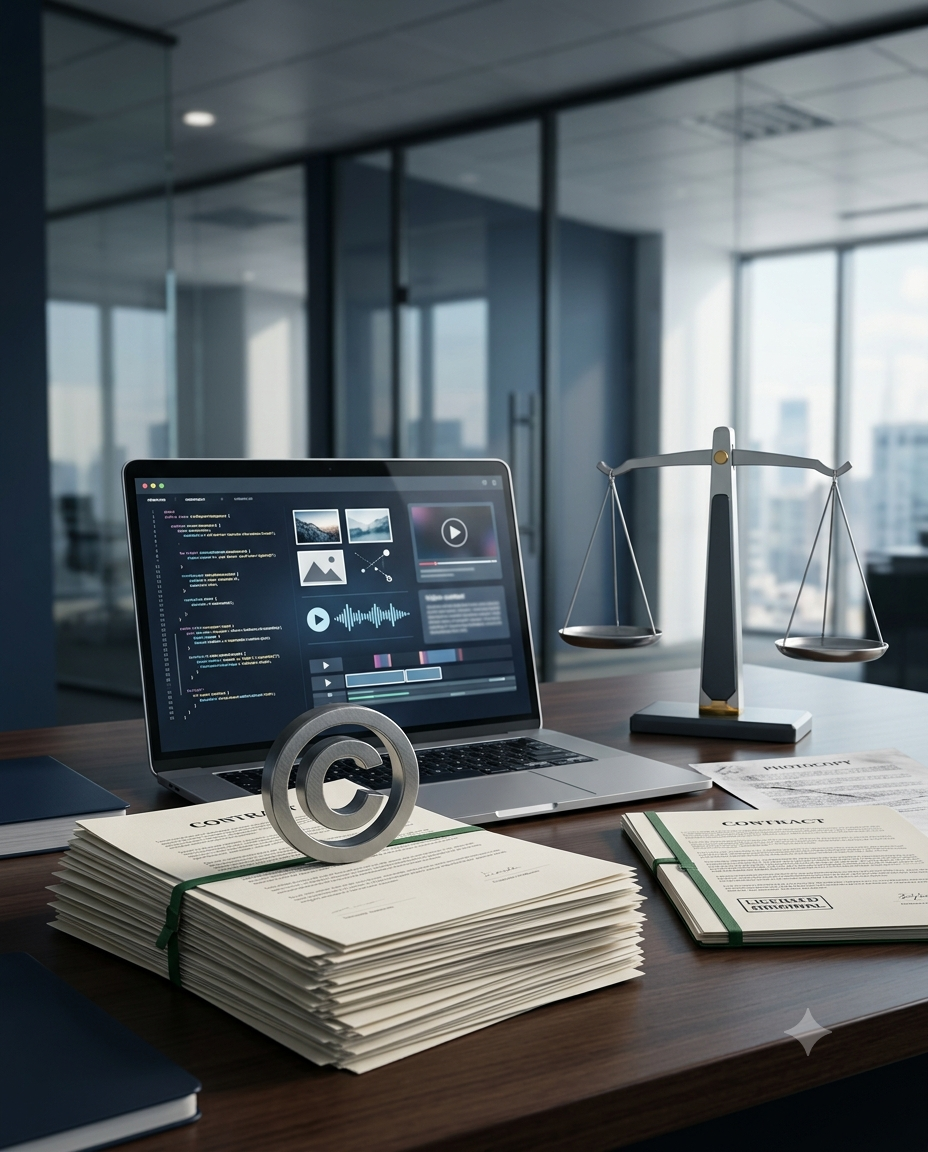
The practical implication for most businesses is broader than they expect. Your website copy is a literary work. Your product photographs are artistic works. Your app’s source code is a literary work — Section 2(ffc) expressly includes computer programmes. The jingle in your advertisement is a musical work. The advertisement itself, as a film, is a cinematographic work.
The threshold for copyright is originality — not novelty. Unlike patents, which require a non-obvious invention, copyright only requires that the work originate from the author and reflect some minimum degree of creative effort. A routine business email probably doesn’t qualify. A well-written product description does.
How Protection Arises — And What Registration Actually Adds
Under Section 13 of the Copyright Act, copyright subsists automatically in qualifying works from the moment they are created. There is no filing requirement, no registration deadline, and no official act required.
Registration, under Chapter X of the Act, is voluntary. But voluntary does not mean irrelevant.
A certificate of registration creates a public record of ownership. It is admissible in all courts as evidence of copyright without requiring further proof. When you seek an urgent interim injunction against an infringer — where the speed of the court’s response depends on the clarity of your legal position — a registration certificate is a significant advantage over an unregistered claim.
For commercially significant assets — software platforms, films, published content, brand identity materials — registration is an investment in enforcement capability, not a box-ticking exercise.
The Ownership Rules Businesses Get Wrong
This is where copyright creates the most commercial problems.
The default position under Section 17 of the Copyright Act is that the author — the person who creates the work — is the first owner of copyright. But there are critical exceptions.
For employees: Where a work is made in the course of employment under a contract of service or apprenticeship, the employer is the first owner — unless the employment contract says otherwise. This covers in-house developers, designers, writers, and marketers.
For contractors: Here, the default flips. An independent contractor who creates a work is the first owner of copyright in that work — not the client who commissioned it and paid for it. The contractor retains copyright unless there is a written, signed assignment to the contrary.
This means the design agency that built your brand identity, the developer who built your website, the photographer who shot your product catalogue — unless each of them signed a written copyright assignment — legally own the copyright in those works.
Section 19 is absolute on this point: an assignment of copyright must be in writing and signed by the assignor or their authorised agent. A verbal agreement, an email confirmation, a WhatsApp message — none of these constitute a valid copyright assignment under Indian law.
Duration of Protection
For literary, dramatic, musical, and artistic works, the copyright term under Section 22 is the lifetime of the author plus 60 years from the calendar year following death. For corporate works, anonymous works, and works of government, the term is 60 years from publication. For films and sound recordings, 60 years from publication.
India’s term aligns with the Berne Convention’s minimum requirements and is broadly comparable to international standards.
Infringement and Remedies
Section 51 defines copyright infringement as doing any act — reproduction, communication, adaptation, translation, performance — that only the copyright owner has the exclusive right to do, without a licence from the owner.
Civil remedies under Section 55 include injunction (interim and permanent), damages, account of profits, and delivery up of infringing copies. Criminal remedies under Section 63 include imprisonment of not less than six months and up to three years, and fines from ₹50,000 to ₹2 lakh. Copyright infringement is a cognisable offence — the police can act without a warrant.
The 2012 amendments added specific provisions on circumventing technological protection measures (Section 65A) — relevant for software, streaming platforms, and DRM-protected content.
What Has Changed in the Digital and AI Era
Digital distribution has made copyright infringement trivially easy and enforcement correspondingly harder. Website scraping, content aggregation, image repurposing, and code copying are all active enforcement areas.
The ownership question around AI-generated content is currently unsettled in Indian law. The Copyright Act 1957 does not recognise AI as an author. Works produced entirely by AI without meaningful human authorship may not attract copyright protection — creating real risk for businesses that rely on AI-generated content assets without any human creative layer.
For any business that creates, licenses, distributes, or acquires content at scale, a copyright audit — mapping assets to ownership, identifying gaps in written assignments, and registering commercially significant works — is a sound and undervalued investment.