

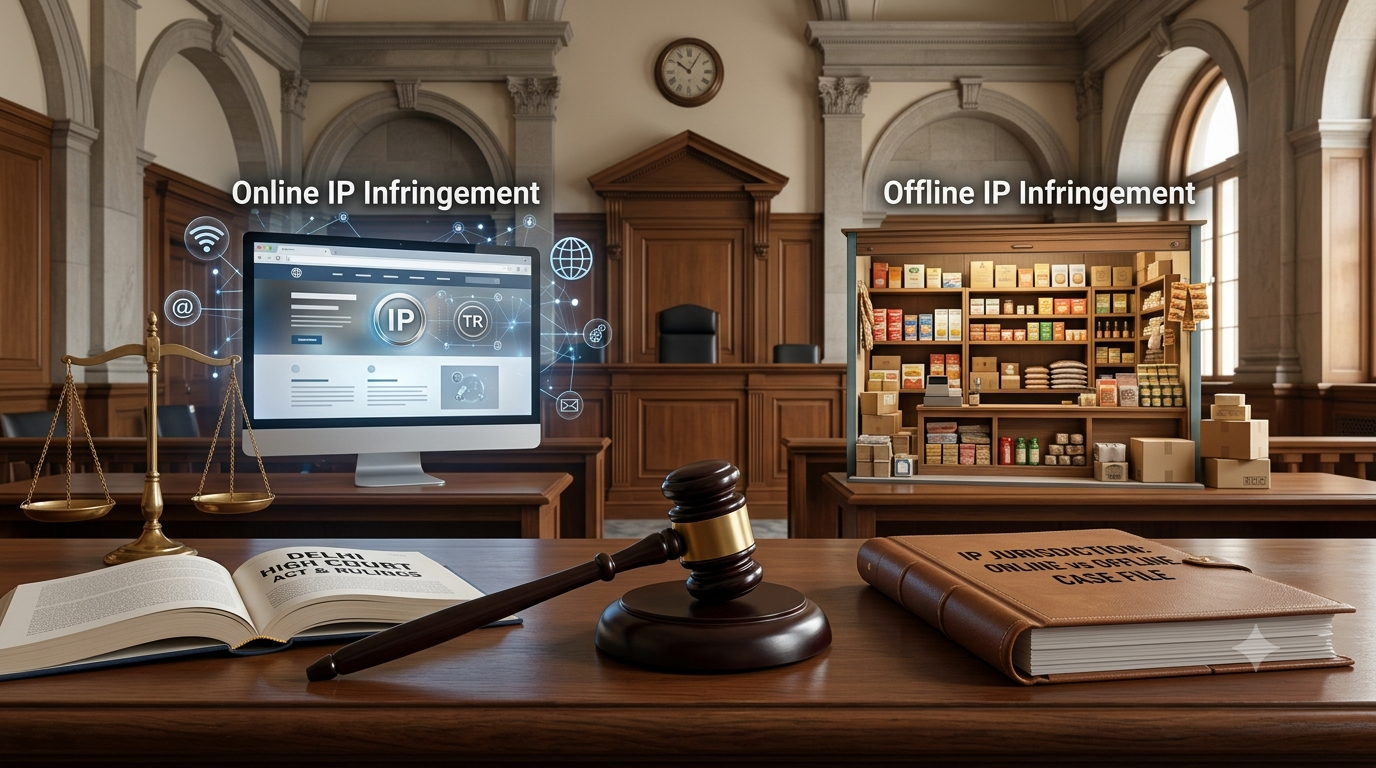
The Delhi High Court has delivered an important ruling on the limits of territorial jurisdiction in intellectual property disputes, holding that website accessibility, online product listings, investigator-generated purchases, and a plaintiff’s choice of forum cannot, by themselves, create jurisdiction. The judgment sets out a structured approach to determining where trademark infringement, copyright infringement, and passing off suits may be instituted.
Introduction
Territorial jurisdiction is often one of the first contested issues in intellectual property litigation. In disputes involving trademarks, copyright, and passing off, a plaintiff may seek relief in a court where it carries on business, where the defendant operates, or where a part of the cause of action has arisen. The growth of e-commerce and digital platforms, however, has complicated this inquiry. A website may be accessible across India, products may be listed on nationwide marketplaces, and online transactions may involve parties situated in different States.
These developments raise a significant question: does the mere accessibility of a website or availability of allegedly infringing goods in a particular city give the courts there territorial jurisdiction?
In a judgment pronounced on 3 November 2026, in a batch of 17 commercial suits, the Delhi High Court examined this question in considerable detail. The judgment, delivered by Justice Purushaindra Kumar Kaurav, analyses the principles governing territorial jurisdiction under Section 20 of the Code of Civil Procedure, 1908 (CPC), Section 134(2) of the Trade Marks Act, 1999, and Section 62(2) of the Copyright Act, 1957.
The Court considered the meaning of “carries on business”, the requirements for establishing a cause of action in online and offline infringement cases, the evidentiary value of investigator-led transactions, and the application of the doctrine of forum non conveniens. It also laid down a practical framework for courts examining territorial jurisdiction at the threshold of an intellectual property suit.
The judgment is particularly significant because it addresses the risk of parties creating an artificial territorial connection with a forum court through carefully constructed pleadings or isolated transactions.
The Legal Framework: Section 20 CPC and the Special Jurisdiction Provisions
Section 20 of the CPC provides the general rule governing the territorial jurisdiction of civil courts. Broadly, a suit may be instituted where:
- The defendant resides, carries on business, or personally works for gain;
- In cases involving multiple defendants, one of the defendants satisfies the statutory requirements, subject to the conditions prescribed under the provision; or
- The cause of action arises wholly or in part.
Intellectual property disputes are also governed by special jurisdiction provisions. Section 134(2) of the Trade Marks Act and Section 62(2) of the Copyright Act permit a plaintiff to institute specified infringement proceedings before a district court within whose jurisdiction the plaintiff actually and voluntarily resides, carries on business, or personally works for gain.
These provisions provide an additional jurisdictional option to eligible plaintiffs. However, the judgment emphasises that the special provisions cannot be interpreted as giving plaintiffs an unrestricted choice of forum.
Drawing upon the Supreme Court’s decisions in Patel Roadways Ltd. v. Prasad Trading Company, Dhodha House v. S.K. Maingi, and Indian Performing Rights Society Ltd. v. Sanjay Dalia, along with the Delhi High Court’s decision in Ultra Home Construction Pvt. Ltd. v. Purushottam Kumar Chaubey, the Court examined the limits of the expression “carries on business”.
The underlying principle is that the special jurisdiction provisions are intended to provide a convenient remedy to plaintiffs, not to enable them to institute proceedings in a distant or otherwise unconnected court merely because they maintain a branch office there.
Meaning of “Carries on Business”: A Branch Office Does Not Automatically Confer Jurisdiction
One of the central issues before the Court concerned whether the presence of a plaintiff’s branch or subordinate office within Delhi was sufficient to invoke the special jurisdiction provisions.
The Court reaffirmed the distinction between a corporation’s principal office and its subordinate offices. Where a corporation has only one office, it is ordinarily deemed to carry on business at that location. Where it has multiple offices, the principal office must first be identified; other offices are generally treated as subordinate or branch offices.
A corporation may be considered to carry on business at a subordinate office when the cause of action for the relevant suit has also arisen at that place. Therefore, the mere existence of a branch office does not independently establish jurisdiction.
The judgment also addresses the position where the plaintiff has its principal office outside Delhi but maintains a branch office in Delhi. The special jurisdiction provisions cannot be used to disregard the statutory limitations recognised in Sanjay Dalia and Ultra Home Construction.
The Court further clarified that a GST registration describing Delhi as a defendant’s “principal place of business” does not automatically establish that the defendant carries on business in Delhi for the purposes of Section 20(a) CPC. The expression under GST law has a distinct statutory meaning and cannot simply be imported into the CPC.
The practical implication: Parties must establish the actual legal and commercial connection of an office with the dispute. A registered address, branch office, or GST registration cannot be treated as an automatic jurisdictional shortcut.
What Constitutes a Cause of Action in Intellectual Property Disputes?
The judgment makes an important distinction between different categories of intellectual property claims. The territorial connection required to establish jurisdiction may vary depending on whether the action concerns passing off, offline infringement, online infringement, or a quia timet claim.
1. Quia Timet Actions: A Real and Imminent Threat Is Necessary
A quia timet action is brought to prevent an anticipated infringement before the threatened wrongful activity has actually occurred.
The Court held that the cause of action for such proceedings arises when the defendant expresses a deliberate intention to undertake an activity that creates a strong possibility of infringement. The threatened activity must be imminent and of such a nature that its occurrence would cause substantial, if not irreparable, prejudice to the plaintiff.
The Court also highlighted the importance of regulatory permissions in cases involving controlled goods and services. For example, where the proposed commercial activity requires a statutory licence, the existence or absence of that licence may be relevant in assessing whether the threatened activity is sufficiently real and imminent.
A general apprehension that a defendant might enter a market is therefore not necessarily enough. The plaintiff must demonstrate a credible and sufficiently immediate threat.
2. Passing Off: Actual Commercial Sales Matter
For passing off claims in the offline world, the Court held that a cause of action may arise where the defendant makes commercial sales of goods bearing the allegedly offending mark within the territorial jurisdiction of the court.
The judgment distinguishes between sales made by a defendant to distributors, wholesalers, retailers, or other commercial intermediaries and the mere availability of products in a particular location.
The mere presence of goods within a territory does not automatically establish jurisdiction. Similarly, the sale of goods by an independent firm that is not acting as the defendant’s distributor, wholesaler, retailer, or agent may not be sufficient to establish the required territorial connection.
The Court also addressed the significance of goods delivered to an investigator or an agent of the plaintiff. Such delivery may, depending on the circumstances, be treated as delivery to the plaintiff or investigator under the principles discussed with reference to Section 39 of the Sale of Goods Act, 1930. This becomes relevant when assessing whether a transaction genuinely establishes a cause of action or has been arranged primarily to manufacture jurisdiction.
3. Offline Trademark Infringement: The Allegedly Infringing Use Must Occur Within the Forum
In an offline trademark infringement action, the Court held that a cause of action may arise where the defendant uses, in the course of trade, a mark identical or deceptively similar to the plaintiff’s registered trademark in relation to the relevant goods or services within the territorial limits of the forum court.
The judgment also clarifies that registration of a trademark within a particular territorial jurisdiction does not, by itself, constitute a part of the cause of action for infringement.
The focus must remain on the defendant’s allegedly infringing commercial conduct and its territorial location.
Online Infringement: Website Accessibility Is Not Enough
Perhaps the most consequential part of the judgment concerns online infringement and the territorial jurisdiction of courts over website-based activity.
The Court reaffirmed the applicability of the Division Bench judgment in Banyan Tree Holding (P) Ltd. v. A. Murali Krishna Reddy. Under the Banyan Tree framework, a plaintiff relying on website activity must prima facie demonstrate that the defendant purposefully availed itself of the jurisdiction of the forum by specifically targeting persons within that territory, resulting in injury or harm to the plaintiff there.
The judgment further emphasises the need to demonstrate commercially concluded transactions between the defendant and persons within the forum court’s jurisdiction through the website in question.
Consequently, the following circumstances, taken on their own, are insufficient to establish territorial jurisdiction:
- A defendant’s website being accessible in Delhi;
- An allegedly infringing product being displayed on an online platform;
- The website having a nationwide reach;
- The presence of online advertisements or product listings;
- Website traffic, followers, or social media engagement originating from Delhi; or
- A general assertion that the defendant is targeting customers across India.
The Court considered the relationship between Banyan Tree and subsequent decisions, including World Wrestling Entertainment, Inc. v. Reshma Collection and Tata Sons Pvt. Ltd. v. Hakunamatata Tata Founders. It reasoned that the requirements laid down in Banyan Tree could not simply be diluted by relying on website accessibility or a broad notion of online targeting.
The judgment also notes a limited relaxation of the requirement to establish completed commercial transactions in circumstances where the plaintiff cannot invoke the special jurisdiction provisions under Section 134(2) of the Trade Marks Act or Section 62(2) of the Copyright Act, and the defendant has no presence in India.
This qualification is important: the Court did not treat the requirement of commercial transactions as an inflexible rule without exception.
The Principle of “Dynamic Effect” Cannot Independently Confer Jurisdiction
The Court also examined whether the territorial effects of an alleged infringement could independently confer jurisdiction on a court under the principle of “dynamic effect”.
The argument, in substance, is that an infringement may have consequences wherever the plaintiff carries on business or experiences commercial harm, even if the defendant’s relevant activity is not otherwise connected with that territory.
The Court rejected this approach as a general basis for establishing jurisdiction. It reasoned that allowing jurisdiction to arise merely because the effects of infringement are felt where the plaintiff has a business presence would undermine the statutory scheme of the Trade Marks Act and Copyright Act.
According to the Court, such an interpretation could make the special jurisdiction provisions ineffective by allowing plaintiffs to rely on the location of their business operations rather than satisfying the statutory requirements.
The judgment therefore concludes that jurisdiction cannot ordinarily be established merely by invoking the “dynamic effect” of an alleged infringement.
Investigator-Led Transactions: Courts Must Guard Against Artificially Created Jurisdiction
Another significant aspect of the ruling concerns the use of private investigators to establish territorial jurisdiction.
In intellectual property disputes, plaintiffs sometimes engage investigators to place orders for allegedly infringing products, arrange delivery to a particular city, and rely on the resulting transaction to argue that a part of the cause of action arose there.
The Court cautioned against permitting this practice to become a mechanism for manufacturing jurisdiction.
As a general rule, a transaction arranged by an investigator or another person engaged by the plaintiff solely to create a territorial connection will ordinarily not be sufficient to establish jurisdiction.
However, the Court recognised two important exceptions:
1. Where the investigator’s involvement is genuinely necessary: The plaintiff may rely on the investigator where the plaint and supporting documents prima facie demonstrate that, but for the investigator’s involvement in establishing the relevant facts, the plaintiff could not maintain the cause of action before another competent court.
2. Where the investigator merely documents existing commercial activity: If the defendant is already supplying the allegedly infringing goods to retailers, distributors, or stockists within the forum territory, an investigator’s purchase from those established commercial channels may be relevant evidence of that existing activity.
The distinction is between using an investigator to discover and document an existing territorial connection and using one to manufacture a connection that would otherwise not exist.
This approach is particularly relevant to brand owners and enforcement teams that rely on investigation reports, test purchases, invoices, courier receipts, and product-delivery records when preparing infringement proceedings.
Forum Non Conveniens: Jurisdiction Does Not Always Mean the Court Must Hear the Suit
The judgment makes a further distinction between the existence of territorial jurisdiction and whether a court should actually entertain a suit.
Even where a plaintiff establishes that a court is technically competent under Section 20 CPC or the special provisions of the Trade Marks Act or Copyright Act, the court may examine whether it is the appropriate forum under the doctrine of forum non conveniens.
The Court held that this doctrine applies to civil suits and requires consideration of the other forums that are legally competent to adjudicate the dispute.
In particular, the court must examine whether the part of the cause of action relied upon is merely incidental, minuscule, or slender, or whether the material, integral, and essential part of the cause of action arose within its jurisdiction.
The judgment identifies several factors that may be relevant:
- Where the plaintiff and defendant have their principal places of business;
- Where the allegedly infringing goods are manufactured, packaged, labelled, or distributed;
- Where the relevant commercial activity actually takes place;
- Where the alleged infringement originates; and
- Whether another court has a substantially stronger connection with the dispute.
For instance, if a plaintiff and defendant are both based outside Delhi and the principal manufacturing, packaging, and distribution activities also take place elsewhere, the mere fact that the defendant’s goods are sold across India, including Delhi, may not make Delhi the most appropriate forum.
The Court also explained that where a plaintiff chooses a forum despite having an available and more closely connected jurisdiction, the reasons for that choice may be examined as part of the inquiry.
Thus, forum non conveniens operates as an additional safeguard against forum shopping, even where a technical jurisdictional basis may otherwise be available.
The Doctrine of Demurrer: Courts Can Look Beyond Clever Drafting
The Court also considered the extent to which a court must accept the averments in a plaint as true while deciding an objection to territorial jurisdiction.
It held that the traditional approach under the doctrine of demurrer has been diluted. Courts are not required to accept every statement in a plaint unquestioningly, particularly where the pleadings appear designed to create an artificial impression of territorial jurisdiction.
A court may examine the supporting documents and pierce through clever drafting. Bald, unsupported, or unfounded statements cannot independently establish jurisdiction.
The judgment also recognises that courts may, where appropriate, put questions to parties under Section 168 of the Bharatiya Sakshya Adhiniyam, 2023, to clarify facts relevant to the jurisdictional inquiry.
This places greater importance on the quality of pleadings and documentary evidence filed with an intellectual property suit.
A Practical Framework for Determining Territorial Jurisdiction
To make its analysis operational, the Court set out a structured approach to examining territorial jurisdiction in intellectual property cases.
Among the situations specifically addressed in its illustrative tables are:
| Situation pleaded | Approach indicated by the Court |
| An out-of-Delhi restaurant accepts enquiries or bookings through a website from Delhi | Enquiries or bookings alone do not establish jurisdiction where the actual service is availed at the restaurant outside Delhi. |
| Social media analytics show substantial traffic or engagement from Delhi | Delhi-based traffic, followers, or engagement alone are insufficient. |
| A Delhi-based intermediary, domain registrar, or web host is added as a pro-forma defendant | The presence of a formal or pro-forma party does not independently establish jurisdiction. |
| GST registration identifies Delhi as the defendant’s principal place of business | The GST expression cannot automatically determine whether the defendant carries on business under Section 20(a) CPC. |
| A plaintiff claims that a defendant will expand sales into Delhi | A credible, imminent threat must be demonstrated for a quia timet action. |
| The plaint alleges widespread sales in Delhi but provides no supporting documents | Unsupported assertions cannot independently establish jurisdiction. |
The Court also set out illustrative circumstances in which forum non conveniens may become relevant. These include cases where the principal commercial activity and the parties’ business presence are elsewhere, while the Delhi connection is limited to a small part of the alleged cause of action.
The framework is not presented as an exhaustive code for every possible factual situation. Rather, it offers guidance for courts applying the statutory provisions and precedents to the facts pleaded in each case.
Application to the 17 Commercial Suits
The judgment does not stop at laying down general principles. It applies its analysis to the individual suits before it, including disputes involving trademarks, copyright, trade dress, and passing off.
One illustrative matter is ABD Maestro Private Limited v. Great Galleon Ventures Ltd. The plaintiff alleged infringement of its “YELLO” trademark, label, trade dress, and copyright in relation to alcoholic beverages. It claimed that the defendant’s “V21” vodka product used a deceptively similar yellow-and-black bottle design, label, and overall presentation.
The plaintiff sought to invoke Delhi’s jurisdiction, among other grounds, by relying on the defendant’s alleged business presence and online activity. The Court examined these assertions against the applicable statutory tests.
It held that the defendant’s GST registration showing Delhi as its principal place of business did not, by itself, establish that it carried on business in Delhi for the purposes of Section 20(a) CPC. The online jurisdiction argument also failed because the requirements of Banyan Tree had not been satisfied: there was no commercially concluded transaction between the defendant and persons within Delhi through the website in question.
The Court further noted that the plaintiff had not adequately pleaded whether the defendant possessed the relevant excise licence in Delhi. Since liquor is a regulated commodity, the licence was material to assessing whether the alleged commercial activity could take place in that territory.
On these grounds, the Court concluded that territorial jurisdiction was not established under Section 20(a) or Section 20(c) CPC, Section 134(2) of the Trade Marks Act, or Section 62(2) of the Copyright Act. It directed that the plaint be returned to the plaintiff for presentation before the court having the requisite territorial jurisdiction, if so advised.
The judgment similarly examines other disputes, including Beiersdorf AG & Anr. v. Duvac Cosmedics & Ors., where the plaintiffs relied on online availability and investigator-led purchases to establish a Delhi connection. The Court scrutinised the evidence and distinguished between commercial activity genuinely taking place within a forum and a transaction arranged to create a jurisdictional link.
The broader significance of the exercise is that the Court assessed each suit on its own pleaded facts rather than treating nationwide online availability as a common jurisdictional basis for all disputes.
Key Takeaways for Brand Owners, Businesses, and IP Practitioners
The judgment offers several important lessons for parties considering intellectual property enforcement proceedings:
1. Jurisdiction must be established through evidence, not assumptions. A website listing, social media presence, GST registration, or general assertion of pan-India sales should not be treated as sufficient without examining the applicable legal test and supporting documents.
2. The special jurisdiction provisions have limits. Sections 134(2) of the Trade Marks Act and 62(2) of the Copyright Act provide an additional forum to eligible plaintiffs, but do not permit proceedings to be instituted in any location where the plaintiff happens to maintain a branch office.
3. Online infringement requires a meaningful territorial connection. Website accessibility and product listings are not substitutes for demonstrating purposeful targeting, injury or harm within the forum, and commercially concluded transactions, subject to the limited qualification recognised by the Court.
4. Investigator reports must be carefully assessed. An investigation may help document existing commercial activity, but a plaintiff should not rely on a transaction arranged merely to manufacture territorial jurisdiction.
5. The most convenient forum may not be the only technically available forum. Courts may consider where the essential parts of the dispute arose and whether another competent court is more closely connected with the matter.
6. Pleadings should be complete and supported. Plaintiffs must disclose material facts and provide documents supporting the territorial connection. Unsupported assertions and artificial pleadings may be disregarded at the jurisdictional stage.
Conclusion
The Delhi High Court’s judgment dated 3 November 2026 provides a detailed examination of territorial jurisdiction in intellectual property litigation in the context of modern online commerce.
Its central message is that digital accessibility does not eliminate territorial boundaries. A website may be visible throughout the country, but that fact alone does not make every court a competent forum for an infringement action. Similarly, a plaintiff’s business presence, an investigator-arranged purchase, or an isolated commercial event cannot automatically create jurisdiction.
By reaffirming the importance of Banyan Tree, clarifying the limits of the special jurisdiction provisions, scrutinising investigator-led transactions, and applying forum non conveniens, the Court seeks to balance the enforcement of intellectual property rights with procedural fairness to defendants.
For brand owners and IP practitioners, the judgment reinforces the need to identify the correct forum before commencing proceedings and to build a jurisdictional case on genuine commercial activity, material facts, and reliable documentary evidence. Ultimately, the ruling underscores that territorial jurisdiction is not a matter of convenience alone; it must be supported by a legally sustainable connection between the dispute and the court approached.