
Your brand is one of the most valuable things your business owns. The name, the logo, the tagline — they carry years of work, trust, and identity. But here’s the thing most business owners don’t realise until it’s too late: none of it is automatically protected.
That’s where a trademark comes in.
What Is a Trademark, Exactly?
A trademark is a sign that distinguishes the goods or services of one business from those of another. Under the Trade Marks Act, 1999 — the primary legislation governing trademarks in India — a mark can include words, names, devices, labels, numerals, signatures, colours, shapes, packaging, or any combination of these.
In simpler terms: if it identifies your brand, it can potentially be a trademark.
Think of the Coca-Cola bottle shape. Or the Nokia ringtone. Or the specific red on a Louboutin sole. None of these are just design choices — they are registered intellectual property that those companies legally own and enforce.
TM vs. ® — What’s the Difference?
You’ve probably seen both symbols floating around on brand materials. They are not interchangeable.
The TM symbol is an informal declaration. It tells the world you’re claiming this mark as yours, but it doesn’t carry legal enforcement rights. Anyone can use TM — registration is not required.
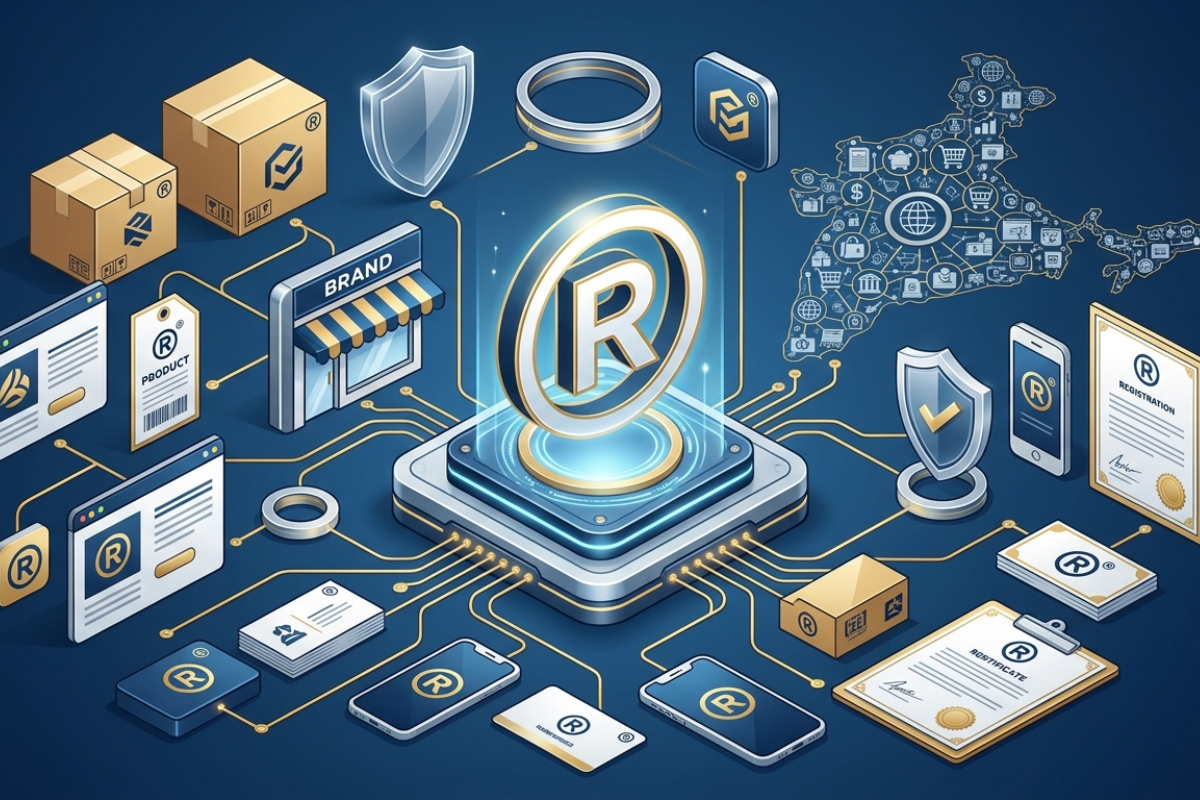
The ® symbol, on the other hand, means the mark is officially registered under the Trade Marks Act. Only registered proprietors can use ®. Using it without registration is actually an offence under Indian law.
Once you have the ®, you have nationwide legal rights. You can sue for infringement. You can license the mark and earn royalties. You can stop others from using a confusingly similar mark in your class of goods or services.
What Can You Trademark?
Trademarks in India are broader than most people assume. You can register:
Word marks — your brand name or a distinctive phrase Device marks — logos and graphical elements Composite marks — a combination of words and devices Three-dimensional marks — distinctive product or packaging shapes Sound marks — unique audio identifiers (the Intel bong is a classic example) Colour marks — a single colour or combination associated exclusively with your brand Collective marks — used by members of a group or association
India follows the Nice Classification system, which divides all goods and services into 45 classes. Your trademark is registered for specific classes, so choosing the right ones matters enormously.
What Cannot Be Registered?
Not everything makes it through the trademark office. Marks that are rejected include:
Generic or common words that describe the product itself (you cannot trademark “Cold Water” for a water brand) Marks that are deceptively similar to existing registered trademarks Anything that is likely to cause confusion among consumers National symbols, flags, government emblems, and certain international organisation symbols Obscene or offensive content Marks that are purely descriptive without acquired distinctiveness
There are also absolute grounds and relative grounds for refusal, and understanding the difference is important when you’re crafting your trademark filing strategy.
Why Does Registration Matter?
This is the question we get most often: “Do I really need to register? I’ve been using this name for years.”
Yes. You do.
Prior use without registration gives you some rights — specifically under the common law doctrine of passing off — but those rights are limited, harder to enforce, and geographically restricted to where you’ve actually been doing business.
Registered trademark rights, in contrast, are nationwide from day one. Registration creates a public record of your ownership. It acts as a deterrent — potential infringers can search the register and see your mark is taken. And when you eventually want to expand, license, franchise, or sell your business, a registered trademark portfolio significantly increases your valuation.
Over four lakh trademark applications are filed in India every year. The register is crowded. The longer you wait, the higher the chance that someone else — in your industry, in your city, building a similar brand — will file before you do.
How Long Does Protection Last?
A registered trademark in India is valid for 10 years from the date of registration. After that, it can be renewed indefinitely for successive 10-year periods. There is no ceiling on how long a trademark can be kept alive — as long as it is renewed and used.
If a trademark is not renewed, it can be removed from the register. At that point, the mark becomes available for anyone to claim. Needless to say, losing a registered trademark due to a missed renewal is a painful and entirely avoidable situation.
A Note on Priority
India operates on a first-to-file system, with some weight given to prior use. But in most cases, the person who files first gets priority. This means that building a brand for months or years without filing puts you at risk the entire time.
The moment you decide on a brand name — ideally even before you launch — is the right time to file.
Final Thought
A trademark is not just a legal formality. It’s the foundation of everything you build under your brand name. Without it, you’re building on rented land.
If you have a name, a logo, or a tagline that represents your business to the world, speak to a trademark attorney. Not next quarter. Now.