

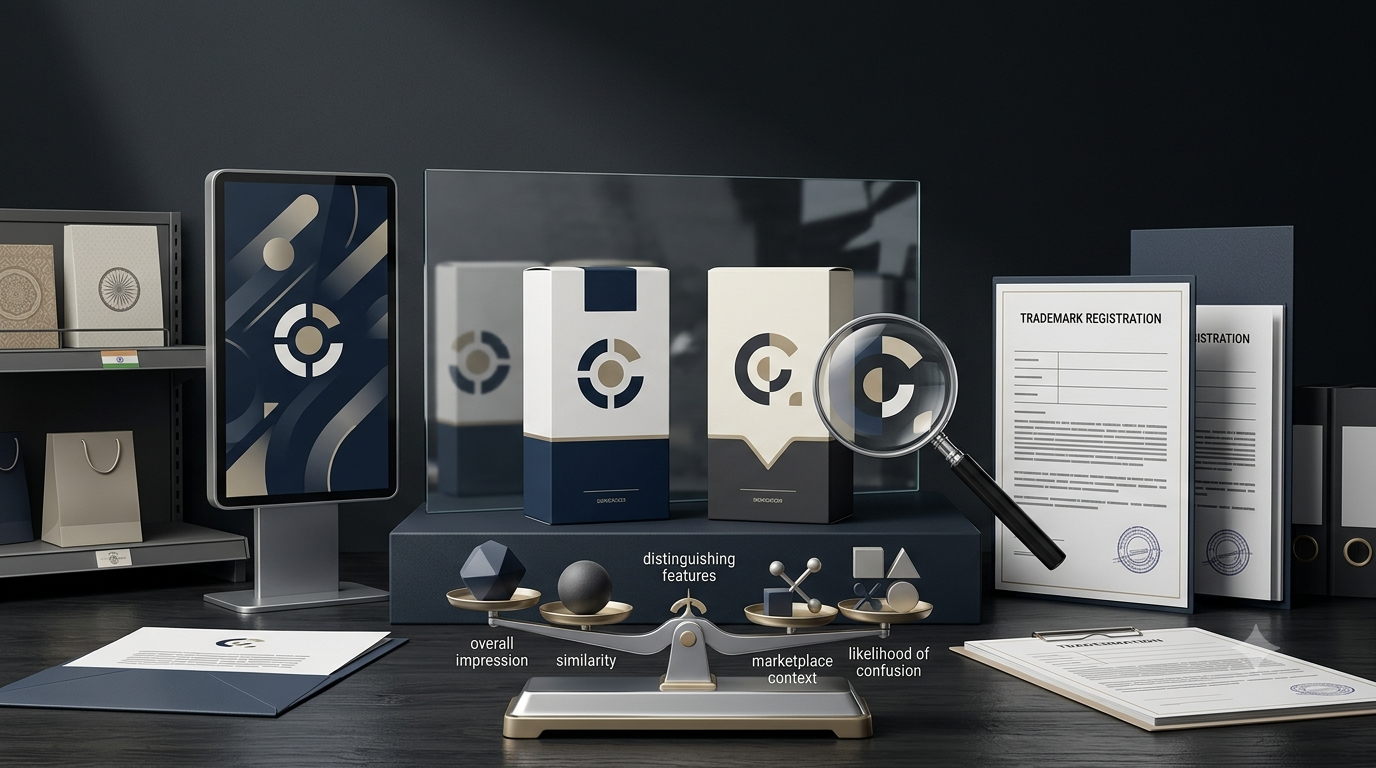
The Telangana High Court’s Approach in Sai Silks (Kalamandir) Limited v. SKP B Gopinath Private Limited & Ors.
Trademark law has traditionally assessed the likelihood of consumer confusion through the lens of a person of average intelligence and imperfect recollection. The underlying principle is straightforward: consumers do not ordinarily place competing trademarks side by side and conduct a detailed comparison before making a purchase. The law therefore focuses on the overall impression that a trademark is likely to create in the mind of the ordinary consumer.
However, consumer behaviour has evolved considerably.
Consumers today encounter brands through search engines, social media, digital advertising, online marketplaces and other information-rich platforms. Against this changing commercial environment, the Telangana High Court, in Sai Silks (Kalamandir) Limited v. SKP B Gopinath Private Limited & Ors., considered whether the traditional formulation of the consumer-confusion test adequately reflects how consumers make purchasing decisions today.
A Division Bench comprising Justice Moushumi Bhattacharya and Justice Renuka Yara referred to the concept of a “perceptive consumer with informed associations”—a consumer who is conscious not merely of the sound of a mark, but also of its source, brand identity, quality and the broader associations connected with the purchase.
The significance of the decision, however, lies not merely in this observation. The Court also examined the competing marks in their entirety, the nature of the products involved and the circumstances in which consumers actually purchase those products.
The Dispute: Similar Words, Different Commercial Presentation
The dispute arose between Sai Silks (Kalamandir) Limited and a competing saree retailer using the mark “Kanchipuram Varahi Lakshmi Silks.”
Sai Silks claimed rights in marks including “Kancheepuram Vara Mahalakshmi Silks” and “Vara Mahalakshmi.” It alleged that the respondent’s mark was deceptively similar and sought interim protection, along with the appointment of a Local Commissioner for inspection and seizure of allegedly infringing material.
The Trial Court declined to grant interlocutory relief. Although it recognised phonetic similarities between portions of the competing marks, it found that the differences in their overall presentation were substantial enough to outweigh those similarities. The Court also found that the respondent had not copied the core and distinctive features of the appellant’s composite mark.
The matter subsequently came before the Telangana High Court.
Moving Beyond the Traditional Consumer
The most significant aspect of the judgment is the Court’s discussion of the consumer-confusion inquiry.
The conventional trademark test assumes a consumer possessing average intelligence but imperfect recollection. This approach reflects the practical reality that consumers generally do not undertake an exhaustive comparison between competing marks before purchasing a product.
The Telangana High Court, however, observed that the contemporary consumer operates in a significantly different commercial environment.
Consumers are continuously exposed to product information and promotional material through print media, digital platforms and social media. As a result, the Court questioned whether it remains appropriate to assume that consumers encounter competing marks only in isolation and make purchasing decisions without access to broader information.
The Court consequently suggested the concept of a “perceptive consumer with informed associations.” Such a consumer may consider not merely how a trademark sounds, but also its commercial source, brand identity, quality and other attributes associated with the purchase.
Importantly, this does not necessarily mean that the traditional consumer-confusion test has been abolished or replaced across trademark law.
Rather, the judgment highlights the importance of considering three interconnected factors:
- the nature of the goods or services;
- the purchasing process; and
- contemporary consumer behaviour.
The assessment of confusion must therefore remain sensitive to the actual circumstances in which consumers encounter and evaluate competing brands.
The Nature of the Purchase Matters
The Court’s reasoning was closely connected to the nature of the goods involved.
Saree shopping was considered a planned and leisure-oriented activity, involving visual and tactile evaluation of the product. The Court observed that a consumer purchasing a saree merely because they heard the name of a particular shop would be an unlikely scenario.
This became particularly relevant because the appellant placed significant reliance on phonetic similarity between the competing marks.
The Court did not disregard phonetic similarity as a relevant consideration in trademark law. Instead, it held that phonetic similarity could not be treated as the sole determining factor in the particular commercial context before it.
The consumer’s actual purchasing experience had to be examined.
For instance, a consumer purchasing an expensive saree from a physical showroom may encounter the brand through multiple elements, including:
- store signage;
- showroom appearance;
- product presentation;
- fabric and design;
- packaging;
- branding; and
- interaction with sales personnel.
This experience is materially different from an impulse purchase where a consumer may encounter a brand name briefly or only through sound.
The decision therefore reinforces an important principle of trademark analysis: the likelihood of confusion cannot be separated from the circumstances in which the relevant goods or services are purchased.
Composite Marks and the Limits of Exclusivity
The Court’s analysis also extended to the constituent elements of the appellant’s composite trademarks and the extent to which exclusive rights could be claimed over individual words.
The Court considered terms such as “Kancheepuram” and “Silks” to be non-distinctive in the relevant trade context. Kancheepuram is associated with the geographical origin of silk sarees, while “Silks” directly relates to the goods or trade.
The Court also considered “Vara Mahalakshmi” in its cultural and religious context. It rejected the proposition that the appellant could claim exclusive proprietary rights over individual components such as “Vara” or “Mahalakshmi”, or variations thereof, merely because those terms formed part of its registered composite mark.
This reasoning is consistent with Section 17(2)(b) of the Trade Marks Act, 1999, which limits the exclusive rights arising from registration of a composite trademark where portions of the mark are common to the trade or otherwise non-distinctive.
The practical implication is significant for brand owners: registration of a composite trademark does not automatically create a monopoly over every individual word appearing within the mark.
Overall Commercial Impression Remains Central
The decision should not be understood as establishing a rule that visual similarity will invariably prevail over phonetic similarity.
Instead, the judgment demonstrates the continuing importance of assessing the overall commercial impression created by competing marks.
In the present dispute, the rival marks appeared as labels rather than merely as isolated word marks. The Court considered the visual differences between the labels sufficiently substantial to outweigh the similarities relied upon by the appellant.
This approach is particularly relevant in modern retail markets, where trademarks frequently operate as part of a broader visual identity comprising:
- logos;
- typography;
- colour combinations;
- packaging;
- storefronts; and
- other distinctive brand elements.
Accordingly, an infringement or passing-off dispute cannot always be reduced to the question of whether two names sound similar when spoken.
What the Decision Means for Modern Brand Protection
The judgment carries several practical implications for businesses developing and protecting their brands.
1. Brand Clearance Should Go Beyond Phonetic Similarity
Businesses should not restrict trademark searches to phonetic similarity alone. Competing marks should be examined in their complete commercial presentation, particularly where the relevant products involve substantial consumer consideration.
2. Composite Trademarks Should Be Structured Strategically
Businesses should identify the genuinely distinctive components of their proposed trademarks and seek protection accordingly.
Registration of a composite mark does not necessarily provide exclusive rights over descriptive, geographical or commonly used expressions contained within that mark.
3. Consumer Behaviour Matters
Digital advertising, social media, online search and digital marketplaces have changed the way consumers discover and evaluate brands.
A consumer may encounter the same brand multiple times and through multiple channels before making a purchase. This broader exposure may be relevant when assessing the likelihood of confusion.
4. The Purchasing Environment Is Important
Businesses and litigants should distinguish between impulse purchases and considered purchases.
Factors such as the price, nature, purpose and purchasing environment of the relevant goods or services may materially affect the likelihood of confusion.
A Cautious Evolution, Not the End of the Traditional Test
Perhaps the most important aspect of the judgment is conceptual rather than doctrinal.
The Telangana High Court’s observation invites courts and practitioners to consider whether a single, uniform conception of the “average consumer” can adequately capture every modern marketplace.
At the same time, the decision arose in a particular factual context involving sarees, composite label marks and substantial visual differences. The Court’s observations should therefore be understood within that context rather than automatically treated as replacing the traditional consumer-confusion test for every category of goods and services.
What the judgment does provide is a useful reminder that trademark law must remain attentive to how consumers actually encounter, evaluate and purchase products.
Conclusion
The Telangana High Court’s decision in Sai Silks v. SKP B Gopinath places consumer behaviour at the centre of the modern trademark-confusion inquiry.
The Court’s reference to the “perceptive consumer with informed associations” reflects the changing commercial environment in which today’s consumers may encounter a brand repeatedly across search engines, social-media platforms, digital advertisements, online marketplaces and physical stores before making a purchase.
For brand owners, the lesson is practical. Effective trademark protection depends not merely on registering a name. It also requires an understanding of:
- the distinctive elements of the mark;
- the purchasing environment;
- competing commercial presentations; and
- the actual behaviour of the relevant consumer.
The future of trademark-confusion analysis may therefore lie not in abandoning the traditional concept of the consumer, but in developing a more context-sensitive understanding of the consumer whose perception trademark law seeks to protect.