
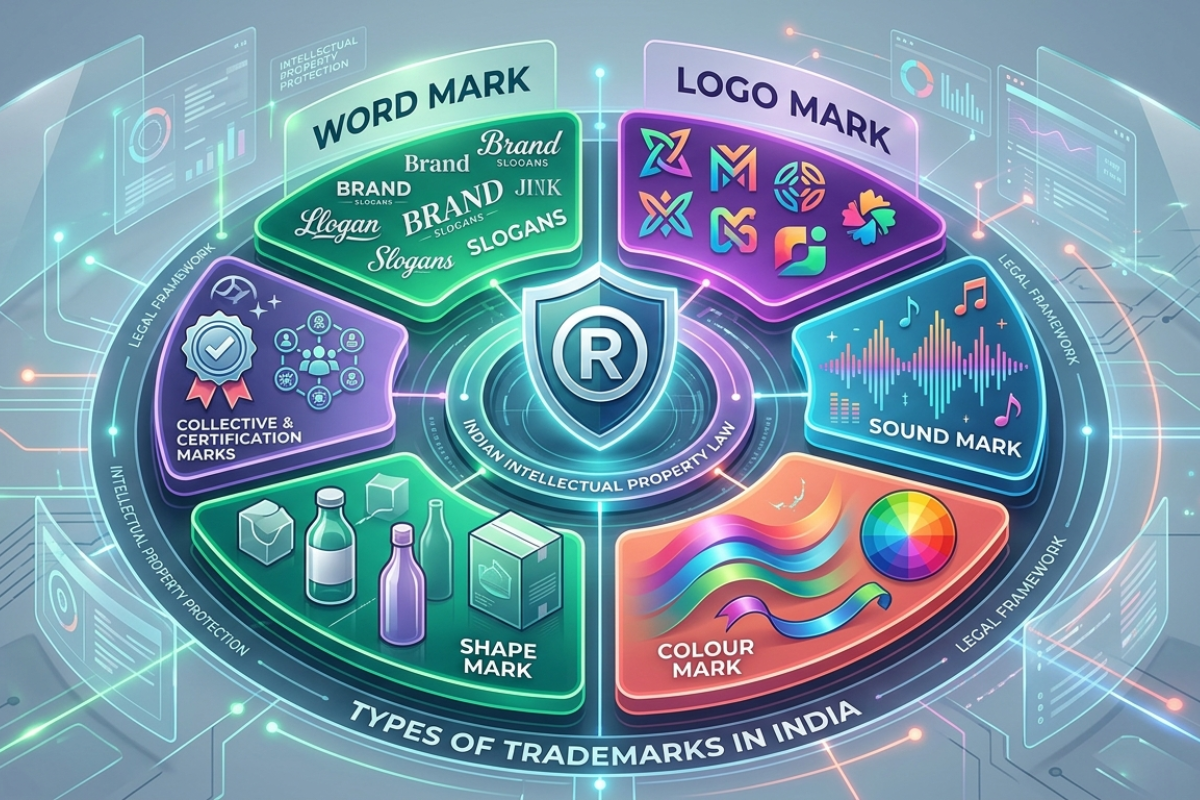
When people think of a trademark, they picture a logo. Maybe a stylised brand name. But trademark law in India recognises a far broader range of marks — and knowing the difference can significantly change how you protect your brand.
Under the Trade Marks Act, 1999, a trademark can be any mark capable of being represented graphically and distinguishing your goods or services from those of others. That definition opens the door to some fairly creative categories.
Here’s a breakdown of all the main types.
Word Marks
A word mark protects the word itself — regardless of font, colour, or stylisation. If you register “Horizon” as a word mark for software services, you own that word in your class. Someone using it in a fancy script font or a different colour can still infringe.
Word marks offer the broadest protection. They’re the foundation of any serious trademark strategy. Brands like TATA, AMUL, and Google are classics — the name is the asset, not just the visual treatment.
Device Marks (Logo Marks)
Device marks protect the specific visual design — the logo, symbol, or graphic element. The Nike Swoosh. The Apple bitten apple. The Pepsi circle.
Unlike word marks, device marks are tied to the specific graphical representation you file. A slight change in colour, proportion, or line weight technically takes you outside the scope of the registration.
Most brand owners file both a word mark and a device mark for complete coverage.
Composite Marks
A composite mark is a word and device combined — essentially how most logos actually look in practice. The Infosys name alongside the Infosys logo. The brand name paired with a graphical element.
Filing composite marks is standard practice in India. But again, serious brand owners also file the word and device separately. If your logo ever changes, your word mark survives the redesign.
Three-Dimensional Marks
Yes, shapes can be trademarks. India’s trade mark rules allow for registration of three-dimensional shapes — whether of a product itself or its packaging.
The Toblerone triangular mountain shape. The Coca-Cola contour bottle. These are not just design choices — they’re registered IP.
Getting a 3D mark registered is harder. You must show the shape is inherently distinctive, and that it doesn’t serve a purely functional purpose. Shapes dictated by the nature of the goods are not registrable.
Colour Marks
The bar is high, but colour marks are possible in India. Christian Louboutin’s red-soled shoe is the most famous example globally. Cadbury has fought extensively to protect its distinctive purple.
To register a colour, you must demonstrate that the colour has acquired distinctiveness through long and exclusive use in your market. A colour that is common in the industry, or that serves a functional purpose, will not qualify.
Sound Marks
Brands have sounds. The Intel five-note jingle. The Nokia default ringtone. The MGM lion’s roar.
India allows sound mark registrations, provided the sound can be represented graphically — typically through musical notation or a spectrogram (a visual representation of the audio waveform). The sound must also be distinctive of your brand, not generic or functional.
Sound marks are rare but increasingly important, especially for digital products, apps, and media brands.
Certification Marks
These are different in nature. A certification mark is not used to identify the source of goods — it certifies that they meet a defined standard. The ISI mark. AGMARK. The Woolmark logo.
The entity that owns the certification mark sets the standards. Authorised users can then use the mark to signal compliance. The owner itself does not trade in the goods; it certifies others.
Collective Marks
A collective mark is used by members of a collective — a trade association, cooperative, or professional body. The mark distinguishes members from non-members.
The key difference from a regular trademark: any qualifying member of the group can use it. The collective organisation owns the registration and governs who can use it.
Which Type Should You File?
The answer depends on what you’re trying to protect and what your brand strategy looks like.
If your brand is built around a unique name, file a word mark first. If visual identity is central, add a device mark. If you have a distinctive sound for your app or product, consider a sound mark. If your packaging shape is unique, a 3D mark is worth exploring.
For most businesses, the practical advice is this: file the word mark, file the device mark, and do it early. The types of marks you add from there depend on how much of your brand equity lies in elements beyond the name and logo.
Trademark registration is not a one-size-fits-all exercise. A strategy tailored to your actual brand assets will protect far more than a generic, one-type filing.